
The software development industry in 2026 is being reshaped by accelerating adoption of AI-powered coding assistants, agentic AI platforms, widespread low-code/no-code tools, cloud-native and edge computing architectures, DevSecOps integration, and microservices-first designs — all driving faster delivery, enhanced security, and automation-driven innovation.
The software development industry encompasses companies and professionals who create software, including mobile apps, websites, business systems, AI tools, and cloud platforms.
In 2026, this industry is changing very fast because of:
- AI-powered coding assistants
- Agentic AI (AI that can plan and act independently)
- Low-code / No-code platforms
- Cloud-native systems
- DevSecOps (security integrated into development)
- Microservices architecture
Now, let’s understand everything step-by-step in an easy way.
Table of Contents
Major Software Development Trends (2026)
| Trend | What It Means (Beginner Explanation) | Why It Is Important |
| AI-Powered Coding | AI helps developers write code faster | Saves time & reduces errors |
| Agentic AI | AI that can complete tasks independently | Automation of complex work |
| Low-Code / No-Code | Build apps without much coding | Anyone can build apps |
| Cloud-Native Development | Apps built directly for cloud | Easy scaling & global access |
| Microservices | Big apps divided into small services | Faster updates & flexibility |
| DevSecOps | Security included from start | Safer software |
| Edge Computing | Processing data near user/device | Faster response time |
| Automation Testing | AI tests software automatically | Improves quality |
AI vs Non-AI Adoption Growth (2020–2026)

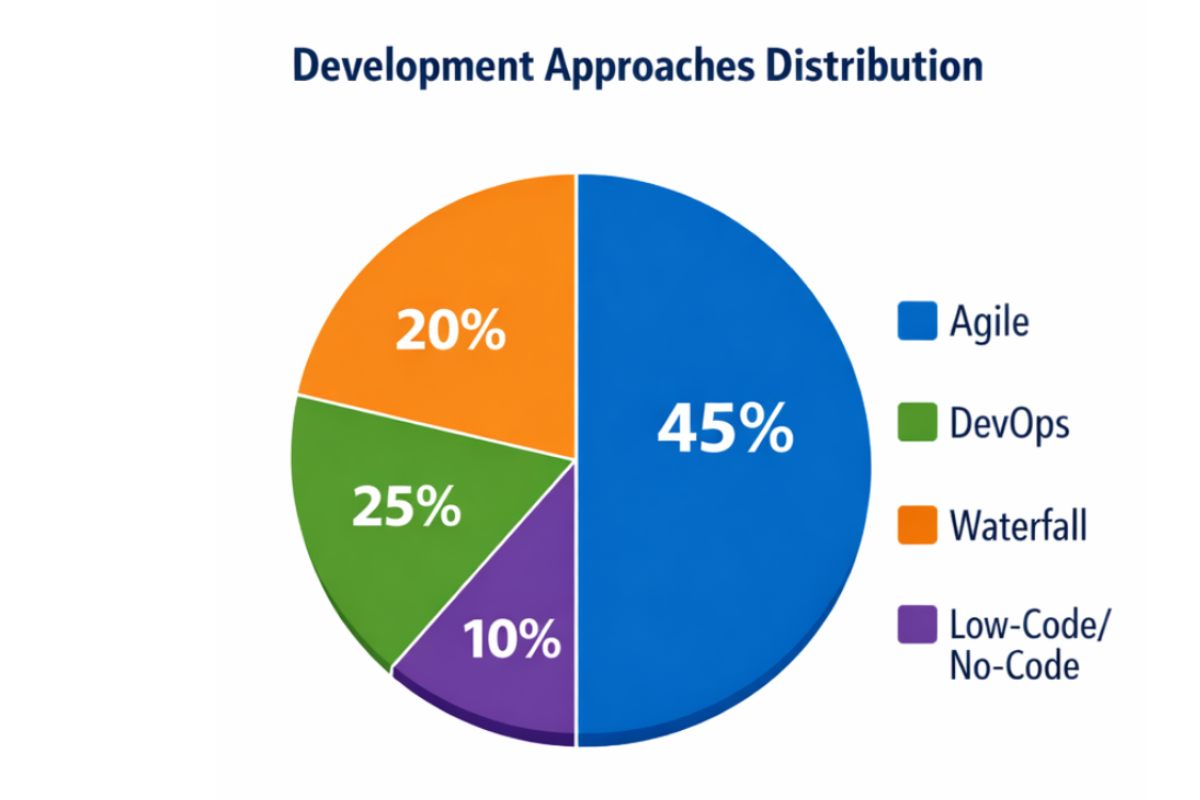
Market Share of Development Approaches
| Development Type | Market Share (2026) | Meaning |
| AI-Assisted Coding | 40% | Most developers use AI tools |
| Low-Code / No-Code | 25% | Business users building apps |
| Cloud-Native Microservices | 20% | Modern scalable systems |
| Traditional Coding | 15% | Decreasing slowly |
Best Software Industries Trending
| Industry | Why It Is Growing | Example Use |
| SaaS (Software as a Service) | Subscription-based income model | CRM, ERP tools |
| FinTech | Digital payments & banking | UPI apps |
| HealthTech | Online healthcare systems | Telemedicine apps |
| EdTech | Online learning platforms | LMS systems |
| Cybersecurity | Rising cyber attacks | Security software |
| AI & Machine Learning | Automation demand | Chatbots, AI tools |
Software Development Industry in India
India is one of the biggest software hubs in the world.
| Factor | Details |
| Major IT Companies | TCS, Infosys, Wipro |
| Startup Growth | Strong SaaS & AI startups |
| Government Support | Digital India initiative |
| Skilled Developers | Large young IT workforce |
| Export Revenue | IT services exported globally |
Why India Is Growing:
- Low development cost
- Strong technical education
- Global outsourcing demand
- Cloud & AI adoption
Technologies & Coding Used
| Area | Example Technologies |
| AI Development | Python, TensorFlow |
| Web Development | JavaScript, React |
| Backend Systems | Node.js, Java |
| Cloud Computing | AWS, Azure |
| Mobile Apps | Flutter, Kotlin |
| Containers | Docker, Kubernetes |
Reasons for Industry Development
| Reason | Explanation |
| Digital Transformation | Businesses moving online |
| AI Automation | Reduces manual effort |
| Remote Work | Need for collaboration tools |
| Cloud Infrastructure | Easy deployment |
| Data Growth | More analytics & AI use |
Future of Software Development
- AI may write 70–80% of basic code
- Fully autonomous AI agents will manage projects
- More no-code platforms for small businesses
- Cybersecurity will become mandatory in all systems
- Quantum computing research will increase
Example: How a Company Uses These Trends
Example Scenario:
- A startup building a delivery app in 2026:
- Uses AI assistant to generate code
- Builds backend using microservices
- Deploys on cloud (AWS)
- Uses DevSecOps pipeline
- Adds AI chatbot for customer service
This reduces cost, time, and improves security.
FAQs
- What is the biggest trend in 2026?
AI-powered coding and automation.
- Will AI replace software developers?
No. AI assists developers, it doesn’t replace skilled engineers.
- Why is low-code popular?
Because non-programmers can build applications.
- Why is cloud important?
It allows apps to run globally without physical servers.
- Is software development a good career in India?
Yes. High demand, good salary, global opportunities.
Conclusion
The software development industry in 2026 is rapidly transforming due to artificial intelligence, automation, and cloud technologies. Modern development now relies heavily on AI-powered tools that help developers write, test, and optimize code faster and more efficiently. Low-code and no-code platforms have also made application development accessible to non-technical users, expanding innovation across industries.
In India, the sector continues to grow strongly because of its skilled workforce, thriving startup ecosystem, and global outsourcing demand. Indian IT companies and SaaS firms are playing a key role in digital transformation through AI-driven and cloud-based solutions.
Looking ahead, the industry will become even more AI-focused and automated. Developers who build skills in AI, cloud computing, cybersecurity, and modern architectures will have excellent career opportunities in this fast-evolving digital landscape.